


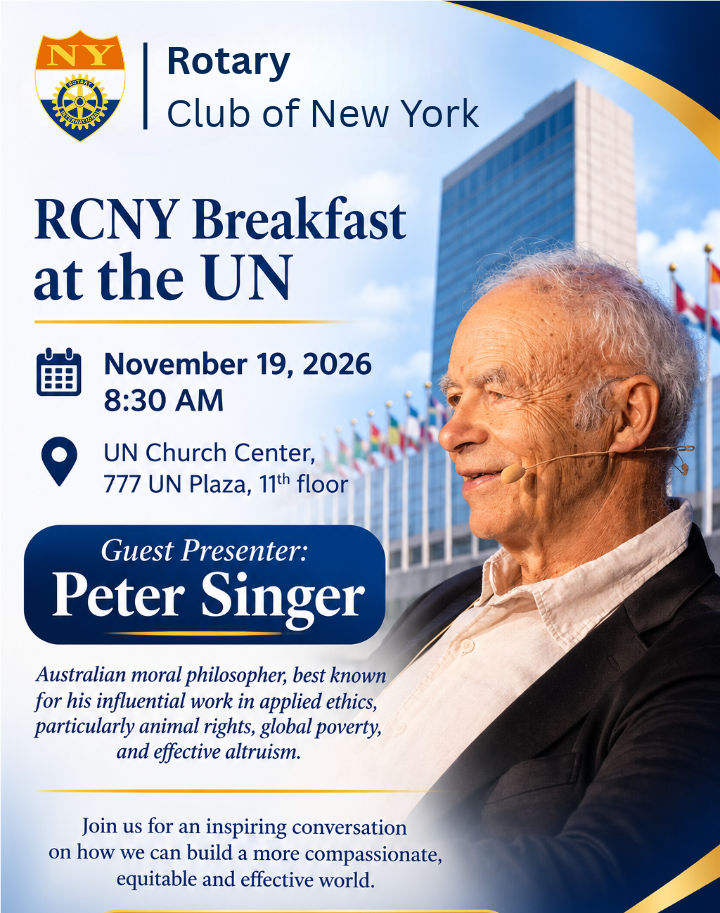
RCNY Breakfast at the UN - November 19, 2026, 8:30am
UN Church Center, 777 UN Plaza, 11th floor
Guest presenter: Peter Singer is an Australian moral philosopher best known for his influential work in applied ethics, particularly animal rights, global poverty, and effective altruism.
Feel free to share link to register here: RCNY Breakfast at the UN - November 19, 2026 | Rotary Club of New York
Bio
Journalists have bestowed the tag of “world’s most influential living philosopher” on Peter Singer. In 1999 he was appointed Ira W. DeCamp Professor of Bioethics in the University Center for Human Values at Princeton University, a position he held until his retirement, and return to his native Melbourne, Australia in 2024.Princeton University then bestowed on him the title of Ira W. DeCamp Professor of Bioethics, Emeritus.Singer first became well-known internationally after the publication of books including: The Life You Can Save: Acting Now to End World Poverty, The Most Good You Can Do Practical Ethics, The Expanding Circle, Rethinking Life and Death, Pushing Time Away, , The Point of View of the Universe (co-authored with Katarzyna de Lazari-Radek), Ethics in the Real World. Peter Singer is co-organizer and co-founder of Profit for Good, a global alliance of businesses that give 10 % or shares to advance causes for the global good.
In 2023, Peter Singer shared the Frontiers of Knowledge Prize for the Humanities with Steven Pinker, awarded by the Spanish BBVA Foundation. Since retiring from Princeton University, he has accepted a regular visiting appointment as VK Rajah Professor of Medical Ethics in the Centre for Biomedical Ethics at the National University of Singapore. Peter Singer also co-hosts the podcast “Lives Well Lived” which has included interviews with Yuval Harari, Jane Goodall, Neil deGrasse Tyson, Kakenya Ntaiya, Adam Grant and Paul Simon.In 2012, Singer was made a Companion of the Order of Australia, the country’s highest civilian honour. In 2021 he was awarded the $1 million Berggruen Prize for Philosophy and Culture, and donated the prize money to effective charities working to reduce suffering, both for humans in extreme poverty, and for animals.
Presentation description
How should we respond when more than 800 million people live in extreme poverty, while development assistance from the governments of most affluent countries is falling, and is now further than ever from the UN's aspirational target of 0.7% of GNI? I shall argue that individuals can make an important contribution by drawing on research about how to donate effectively, and companies also have a role to play. I will introduce the idea of "Profit for Good," which seeks to establish a new standard of success in business. It is not enough to make profits. It is also necessary to make them matter. That can be done by using a substantial proportion of profits - a minimum of 10%, although some donate 100% - to do good. If consumers then favor companies that meet this standard, it can be a win/win for both the businesses and the causes to which they contribute.
